
'On The Border'
When Dionysus walked on Venice Beach.....

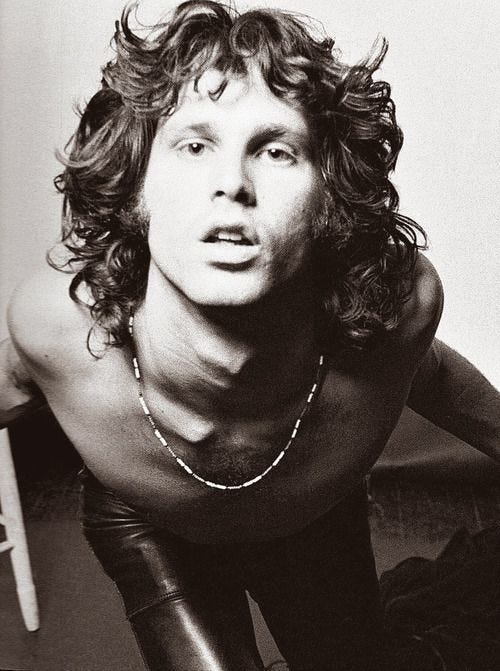
On the 3rd of July 1971, James Douglas Morrison departed on his last journey from an apartment on Rue Beautreillis, in the Le Marais quarter of Paris, and never came back.
He was 27.
He would not be the first, nor the last, tortured artist to die at that ominous age.
But he would become, unwillingly, the blueprint for the cursed rock frontman, blessed with beauty, charisma, a unique stage presence, a distinctive voice, and a lyrical talent fine-tuned through his devotion to similarly cursed literary heroes: William Blake, Rimbaud, Baudelaire, Nietzsche, Aldous Huxley.
All of that paired with a voracious appetite for excess and self-destruction.
His short but legendary journey started, as immortalised in Oliver Stone’s biopic, in the summer of 1965, a chance encounter on Venice Beach with his UCLA classmate Ray Manzarek, a fellow student on a cinematography course. As the two got talking about music, Jim began singing verses of what would become one of their signature songs, “Moonlight Drive”.
And with that, The Doors were born.
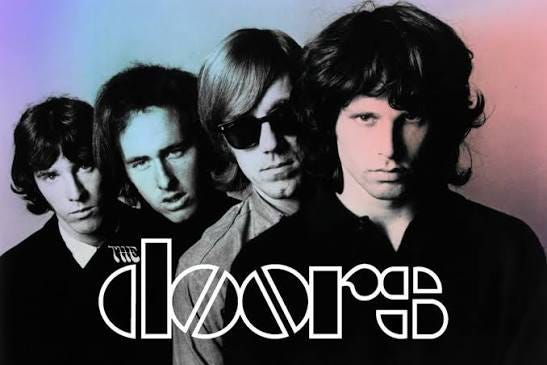
Jazz-loving drummer John Densmore and guitarist Robbie Krieger joined shortly after, completing a lineup that would prove, in its chemistry and tension, utterly unique.
They began honing their Blues sound, veined with psychedelic influences, playing in a little club on the Sunset Strip in West Hollywood — The London Fog — for ten dollars a night. There, and soon after at the more established Whisky a Go Go next door, Jim began to understand how his unconventional, chaotic, experimental stage presence was making converts in the LA underground scene — and drawing the attention of the record companies.
Recording the First Album
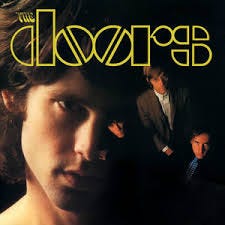
The Doors entered Columbia Recording Studio in August 1966 with producer Paul Rothchild and engineer Bruce Botnick, and recorded their debut album in a matter of weeks. The material had been road-tested relentlessly through their Sunset Strip residencies, and it showed: the album sounds like a band that knows exactly who it is, which for a debut is extraordinarily rare. Rothchild later described the sessions as among the most exciting of his career, the band playing almost entirely live in the room with minimal overdubbing. The absence of a bass player, Manzarek covered the bass lines with his left hand on a keyboard bass, gave the record a spare, slightly eerie quality that no other band of the era quite replicated. The tone throughout is somehow hypnotic.
"Break On Through (To the Other Side)" opened the album like a door being kicked off its hinges. “The Christal Ship” a languid lullaby among our 60s favourite tracks. And then there was "Light My Fire", co-written by Krieger, extended to over seven minutes on the album to accommodate Manzarek and Krieger's duelling solos, a track that would eventually be trimmed to single length and spend three weeks at number one on the Billboard Hot 100 in the summer of 1967. But the album's most extraordinary moment was its closer: "The End," an eleven-minute Oedipal odyssey that allegedly caused their Whisky a Go Go residency to be terminated the night Morrison first performed it live, the management pulling the plug mid-song.
On record it remains one of the most unsettling things committed to tape in the rock era…..part poem, part ritual.
The Shaman, The Lizard King
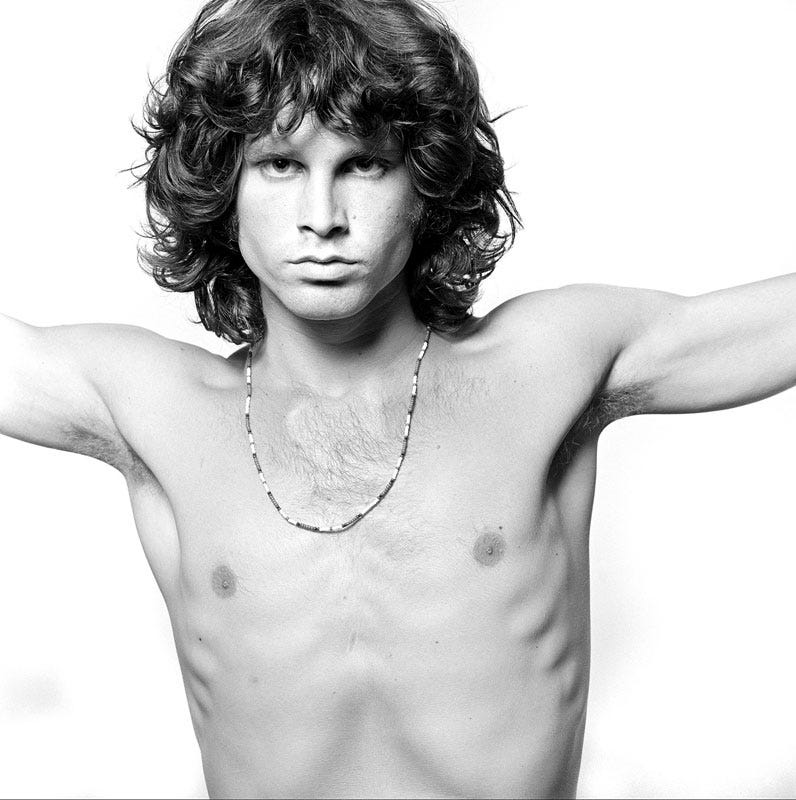
The persona didn’t arrive fully formed , it evolved, performance by performance, through a process that seemed less like artistic construction and more like an authentic journey of personal discovery. Morrison had been deeply marked by Friedrich Nietzsche’s concept of the Dionysian, the ecstatic, irrational, destructive counterpoint to Apollonian order, and by the Native American shamanic traditions he’d encountered through his reading of anthropologist Carlos Castaneda. He came to believe, and said so often enough that people stopped dismissing it, that the soul of a dying Navajo shaman had entered him as a child after witnessing a road accident in the New Mexico desert, an image he returned to repeatedly in his lyrics.
On stage, this translated into something genuinely unpredictable and at times frightening: long silences, improvised spoken-word passages inserted mid-song, his body contorting and pressing against the microphone stand as if wrestling something invisible. He called himself the Lizard King, part irony, part genuine mythologising and began appearing on stage in leather trousers that became as iconic as any costume in rock history. The beauty didn’t hurt: he had the kind of face that cameras loved and audiences projected onto, and for a period in 1967 and 1968 he was as close to a rock god as the era produced. The problem, already apparent to those around him, was that Morrison couldn’t always locate the boundary between performance and reality.
The shaman was becoming the persona, and the persona was swallowing the man.
The Ed Sullivan Show
By September 1967 The Doors were one of the hottest bands in America, “Light My Fire” having spent the summer at the top of the charts. An appearance on The Ed Sullivan Show, still the most coveted primetime television slot in the country, the same stage that had launched The Beatles to American audiences three years earlier. Sullivan’s producers had one condition: the line “Girl, we couldn’t get much higher” in “Light My Fire” had to go, replaced with something less overtly drug-referencing. The band agreed. Morrison DID not.
Standing before an audience of millions, he sang the original lyric anyway, cool as you like, as if the conversation backstage had never happened. Sullivan was furious, reportedly storming backstage to confront the band and telling them they would never appear on his show again. He was true to his word. The rest of the band were reportedly livid too, having been promised further appearances on one of television’s most powerful platforms, all of which evaporated in the thirty seconds it took Morrison to deliver one line. Morrison’s response, when asked about it afterward, was characteristically blase’. He said he had simply forgotten. Nobody believed him.
Strange Days — The Second Album
Released in September 1967, just months after the debut, Strange Days found The Doors doubling down on the psychedelic and the unsettling rather than chasing the mainstream success “Light My Fire” had handed them. Where the debut had been lean and urgent, Strange Days was stranger in texture and more willing to experiment , Rothchild and Botnick layering the production with theremin, cello, and sound effects that gave the record an almost cinematic quality. The title track opened with a carnival-like dissonance that felt genuinely threatening, and “People Are Strange”, one of Morrison’s most compact and perfectly formed lyrics, written during a bout of depression after a walk through the Hollywood Hills, became a top twenty hit on both sides of the Atlantic. “Love Me Two Times” gave the band their most straightforwardly bluesy single, while “When the Music’s Over” anchored the album’s second half with another extended, ritualistic closer in the vein of “The End”, seventeen minutes of crescendo intensity that ended with Morrison screaming “We want the world and we want it — NOW.”
The album reached number three on the Billboard 200, confirming that the debut’s success was no accident, and that The Doors were building something with genuine longevity. What nobody could have predicted was how quickly it would begin to unravel.
The Descent
The rot set in gradually, then all at once. Morrison had always drunk heavily, but by 1968 the drinking had become something darker, a systematic dismantling of the very instrument that had made him extraordinary. He began missing recording sessions, arriving hours late or not at all. On stage, the shamanic intensity that had made early Doors shows genuinely transcendent curdled into something embarrassing and then alarming: long, incoherent spoken-word passages while the band vamped behind him, confrontations with security, nights when he simply turned his back on the audience and refused to perform. The infamous Miami incident of March 1969, during which Morrison allegedly exposed himself on stage, charges he always denied, resulted in a felony conviction, a wave of concert cancellations as venues refused to book them, and what amounted to a slow-motion professional collapse.
The band continued recording, Morrison Hotel (1970) marked a partial return to their raw blues roots, and L.A. Woman (1971), recorded just weeks before Morrison left for Paris, contains some of his finest and most unguarded vocal performances, as if he knew it was farewell.
He had told friends he was going to Paris to write poetry, staying with the love of his life Pamela Courson, to escape the Lizard King persona that had consumed him, to become simply Jim Morrison again.
He was found in the bathtub of the Rue Beautreillis apartment on the 3rd of July.
No autopsy was ever performed.
He was buried in Père Lachaise cemetery, a short walk from the graves of Oscar Wilde and Frédéric Chopin, two artists who burned brilliantly but as briefly at a grave personal cost.
He went to Paris to find himself, and instead found the end he had been writing about all along…..
Thank you for your support as usual, and if this or any of the previous posts resonated, please forward it to one person you know should be in this community !
See you soon….On the border. 🎵